
Julian Marcoux
Email: julian.marcoux@unil.ch
About
I am a fourth-year PhD candidate at the University of Lausanne (HEC), advised by Mathias Thoenig (chair), Aurélien Eyquem (co-chair), and Mathieu Couttenier (external).
My research uses tools from international economics and quantitative spatial economics to answer questions related to geoeconomics, mainly conflict and energy security.
I am a member of the Next-Geo cohort of the Kiel Institute and a 2026 Dartmouth Globalization PhD Fellow.
Research
Working Papers

Abstract
This paper presents a framework for estimating and simulating a quantitative spatial model of trade and violent conflict. In this new theoretical and empirical setup, designed for the analysis of bilateral flows, we first model the general equilibrium interactions between the economic and fighting margins in a micro-founded setup. We then show how the structural parameters can be recovered from the data in a simple and transparent way. A central element of the procedure consists in estimating a structural gravity equation of violence. Studying continental Africa over the period 1997 to 2023, we test the key predictions of the model and uncover new facts related to spatial frictions and conflicts. Finally, the model is simulated to quantify different policy-relevant experiments in weakly institutionalized contexts where insecurity is pervasive. Spatially-diffusing feedback loops between economic shocks and violence are one of the main findings of our analysis.
Abstract
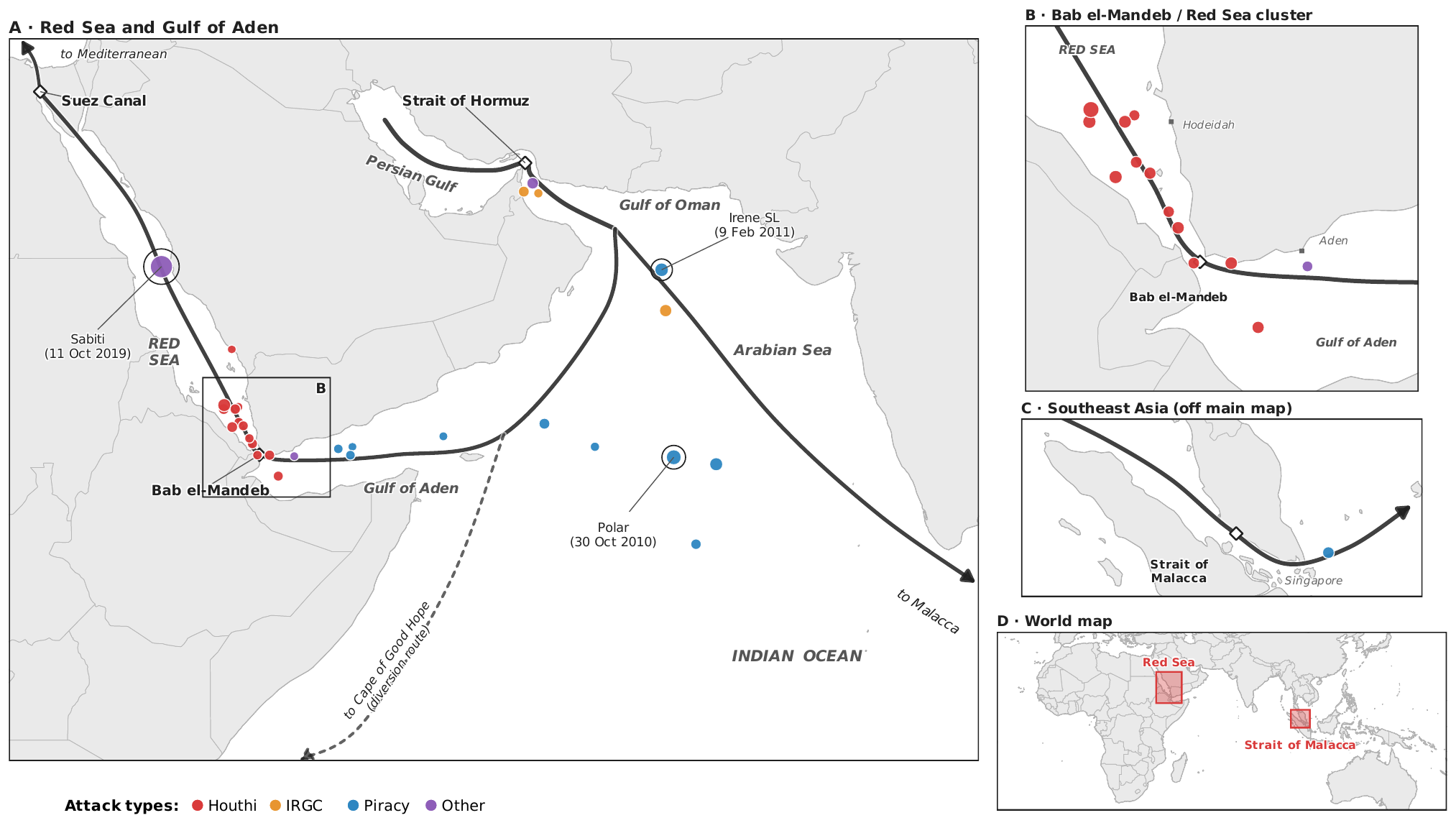
This paper studies the macroeconomic effects of attacks on oil tankers. We identify oil-shipping-cost shocks by combining a narrative record of attacks on oil tankers along key routes in the Middle East and Southeast Asia with high-frequency changes in tanker freight rates. Focusing on the period following the U.S. shale expansion, we find that these shocks lower economic activity and raise consumer prices in both the United States and the world economy. These responses differ from those associated with conventional oil supply shocks and disruptions to dry-bulk shipping. Especially, crude production and oil prices show no significant immediate response, while inventories decline. Moreover, U.S. evidence points to an energy-trade channel, with increased congestion at Middle Eastern ports, lower crude imports and refinery inputs, leading to higher fuel prices. We also document that manufacturing orders and shipments fall immediately, consistent with precautionary adjustments in firms’ purchases and investment plans. These findings, together with the contraction in global activity, suggest that oil-shipping disruptions can hurt both oil-importing and oil-exporting economies.
Work in Progress
Abstract
Coming soon!
Teaching
- Macroeconomics (2nd year Bachelor) Since 2023 Teaching Assistant · University of Lausanne
- Econometrics (2nd year Bachelor) Since 2023 Teaching Assistant · University of Lausanne
Activities
- 1st Lausanne PhD Macroeconomics Conference 2025 Co-organizer
- Lausanne Theory for Applied Micro — Reading Group & Seminar Since 2024 Co-founder & co-organizer
- Micro Research Cluster (Geneva, Lausanne & IHEID) 2022–2024 Co-organizer
Visiting
- Dartmouth College, Department of Economics Mar–Jun 2026 Globalization PhD Fellow
- Kiel Institute for the World Economy, Berlin Jan–Mar 2026 Visiting PhD student · invited by Prof. Christoph Trebesch
- Global Capital Allocation Lab, Stanford GSB Aug 2025 Visiting PhD student · invited by Prof. Matteo Maggiori